J
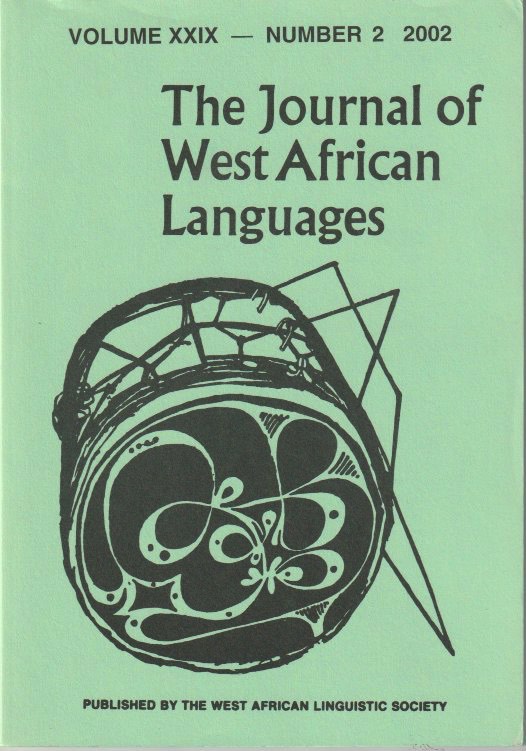
Volume XXIX, Number 2 · 2002
JWAL
Vol. XXIX, No. 2
The Journal of West African Languages
About this Issue
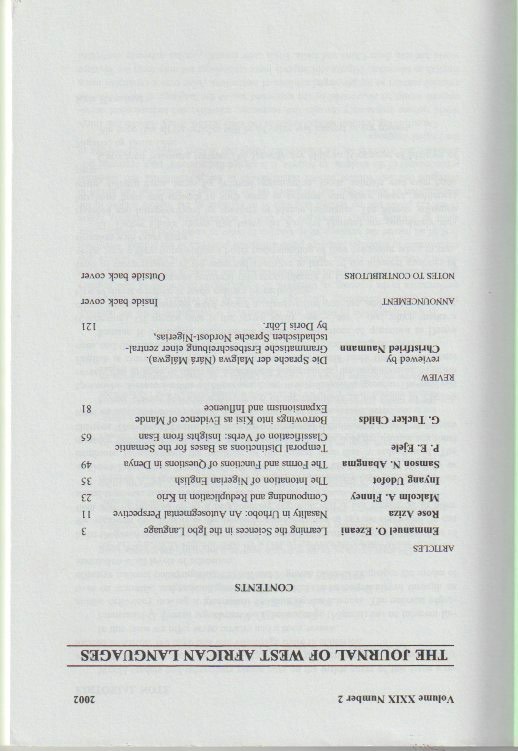
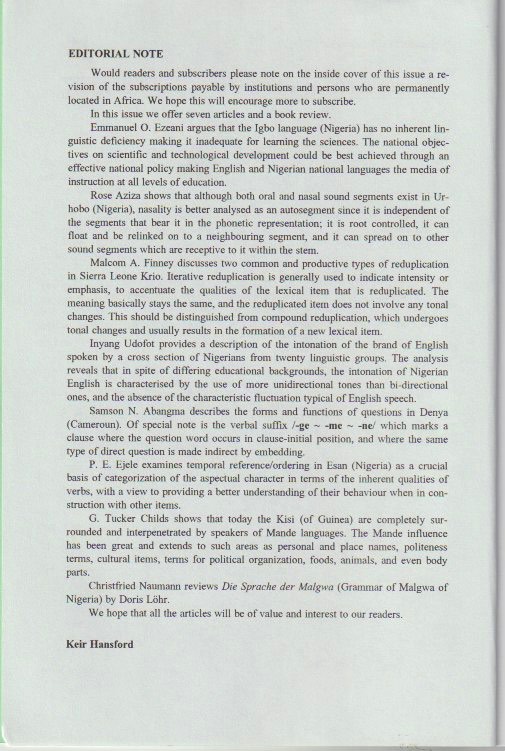
Volume XXIX, Number 2, 2002, edited by Keir L. Hansford. Seven articles and a review, six of them on Nigerian material: Emmanuel O. Ezeani argues that Igbo carries no inherent linguistic deficiency that would make it inadequate for teaching the sciences, and that national policy should make English and the Nigerian national languages the media of instruction at every level; Rose Aziza analyses nasality in Urhobo as an autosegment, root-controlled and able to float and relink; P. E. Ejele takes temporal distinctions as the basis for classifying Esan verbs; and Inyang Udofot describes the intonation of Nigerian English as spoken across twenty linguistic groups, finding it marked by unidirectional rather than bi-directional tones. Malcolm A. Finney distinguishes iterative from compound reduplication in Sierra Leone Krio; Samson N. Abangma treats questions in Denya (Cameroun); and G. Tucker Childs shows the Kisi of Guinea now surrounded and interpenetrated by Mande speakers, whose influence reaches personal and place names, politeness terms, foods and body parts. Christfried Naumann reviews Doris Löhr’s grammar of Malgwa, a Central Chadic language of north-east Nigeria.