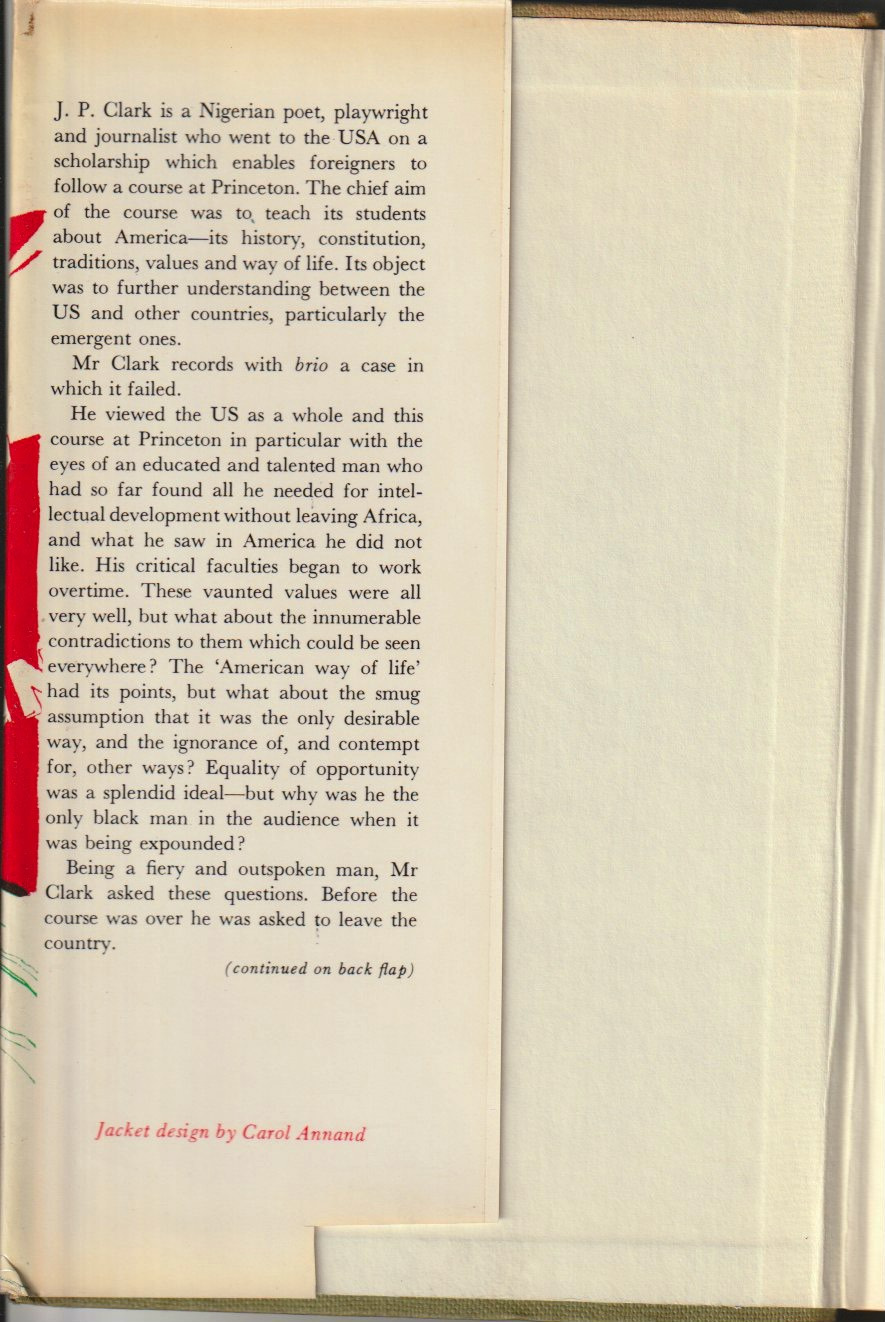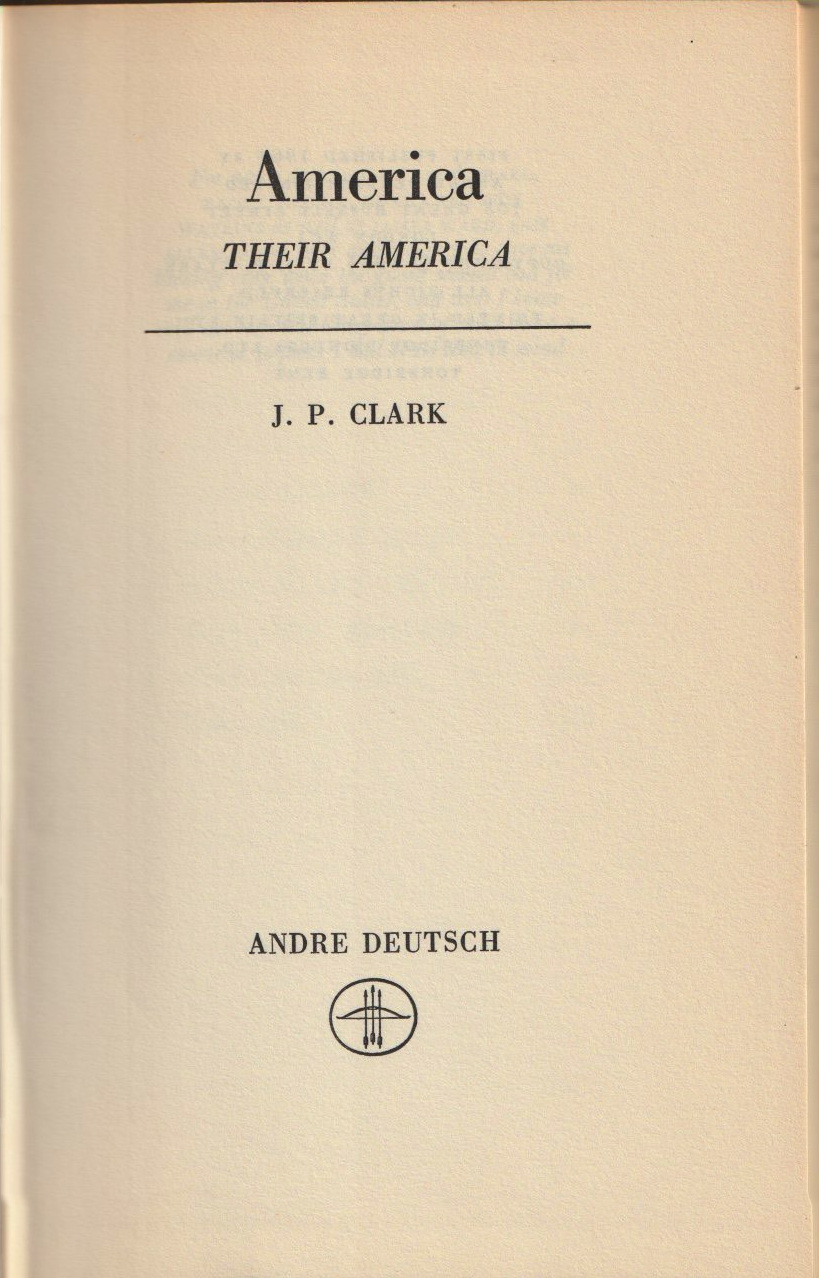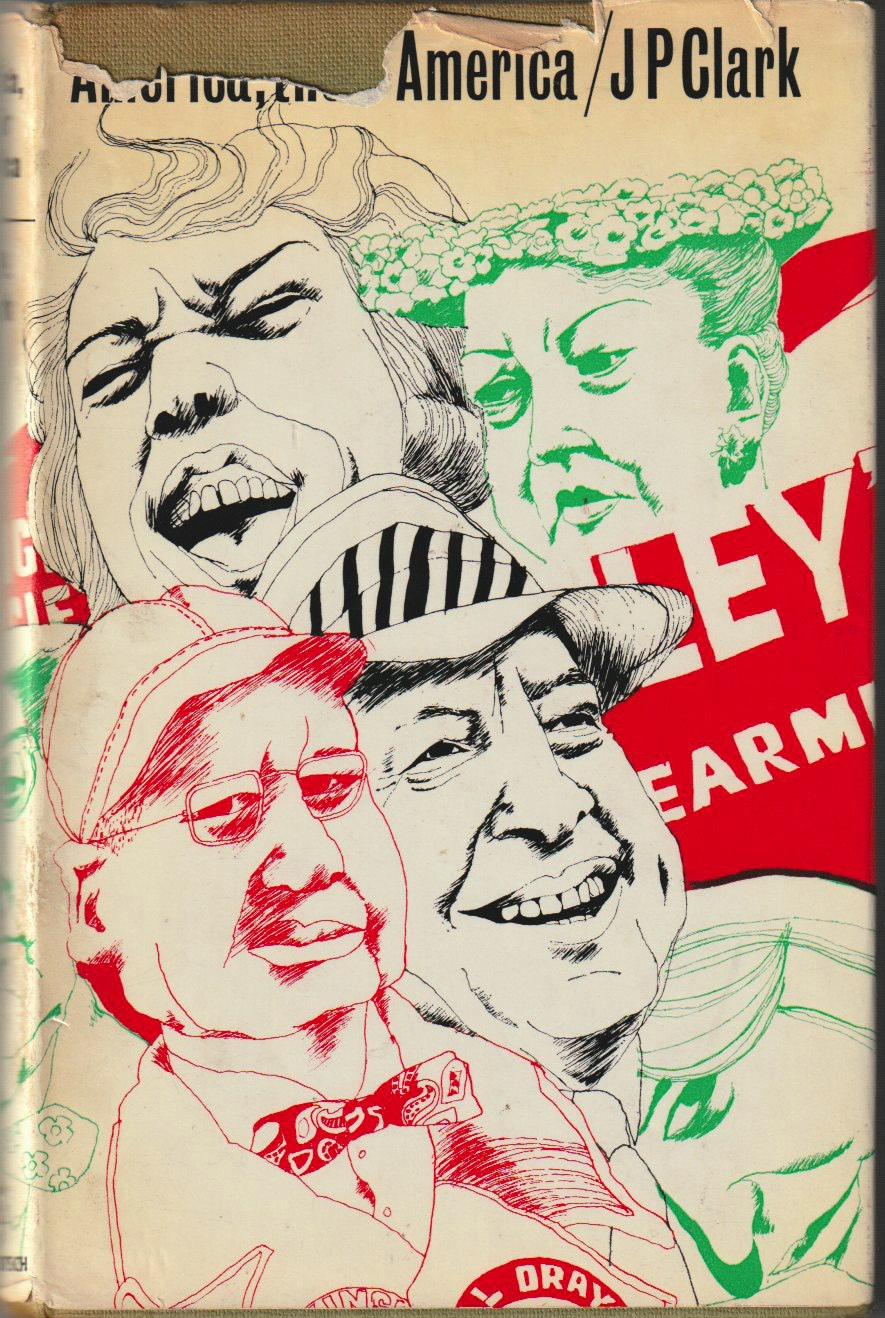
Clark’s account of the year he spent in the United States on a Parvin Fellowship at Princeton — a programme designed, as the jacket puts it, to teach foreign students about America and so further understanding between the United States and the emergent countries. The flap then adds, drily, that Clark “records with brio a case in which it failed”.
The jacket is unusually candid about why. It describes a man who had “found all he needed for intellectual development without leaving Africa”, and who did not care for what he saw. Clark was dismissed from the fellowship before it ended. The book that came out of it is one of the sharpest pieces of reverse-ethnography in African writing of the period.
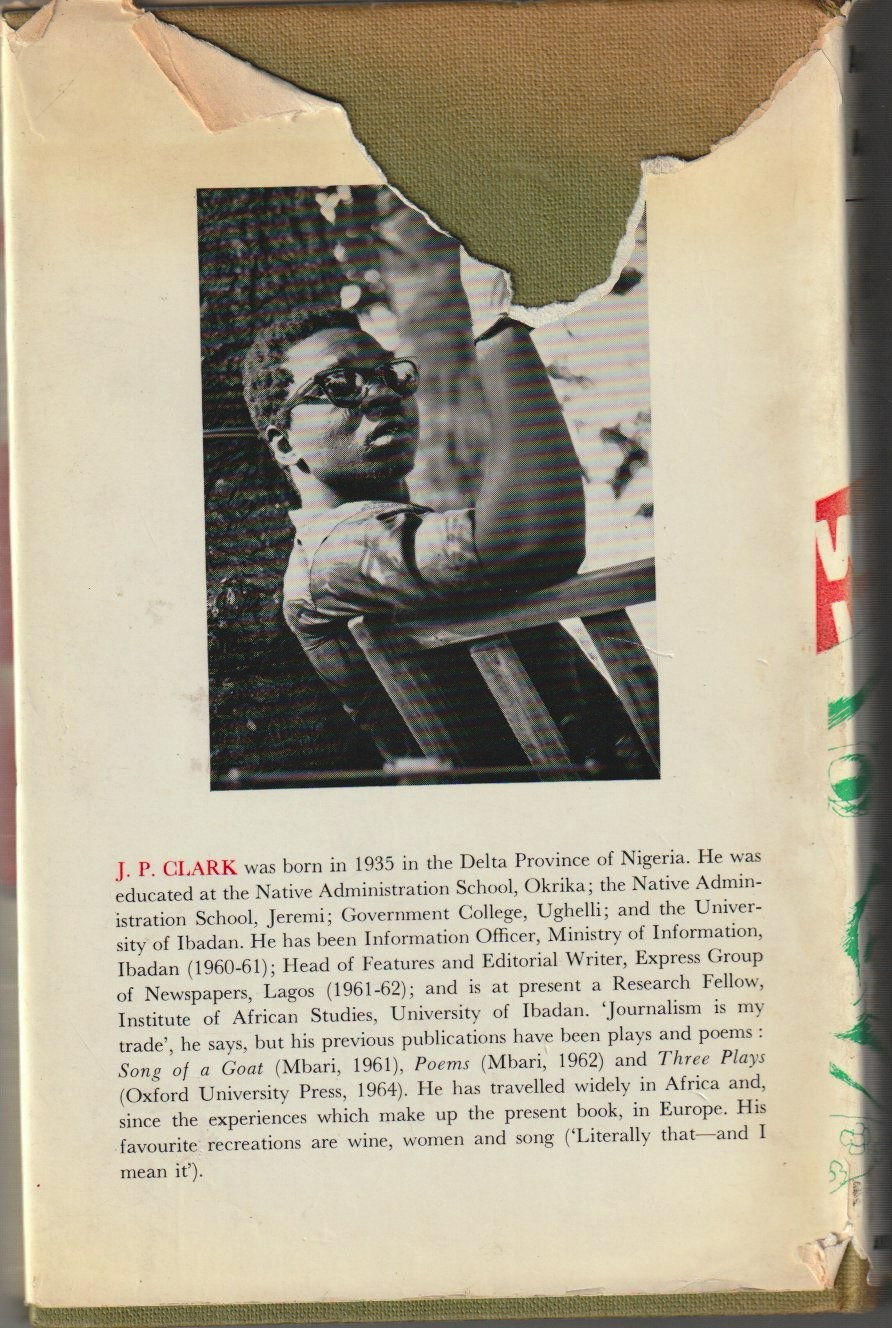
The author note dates him precisely: born 1935 in the Delta Province, schooled at Okrika, Jeremi, Government College Ughelli and the University of Ìbàdàn; Information Officer at Ìbàdàn 1960–61, then Head of Features at the Express Group in Lagos, and at the time of writing a Research Fellow at the Institute of African Studies, Ìbàdàn. It lists his previous books as Song of a Goat (Mbari, 1961), Poems (Mbari, 1962) and Three Plays (Oxford, 1964) — the first two of which are held in this Library’s Mbari Publications collection. It ends by giving his favourite recreations as “wine, women and song”, with the parenthesis “Literally that — and I mean it”.
This is one of the books discussed at length in A Book Collector’s Journal, alongside Ọlábísí Àjàlá’s An African Abroad — the pair of them early portraits of a Nigerian professional class abroad, confident and unafraid to say what it saw.